
Part of our work on insurance
Insurance
Claims Intake Is the Easiest Thing in Your Agency to Automate. Automate It Second
Big Sky Consulting Group · September 2, 2026 · 7 min read
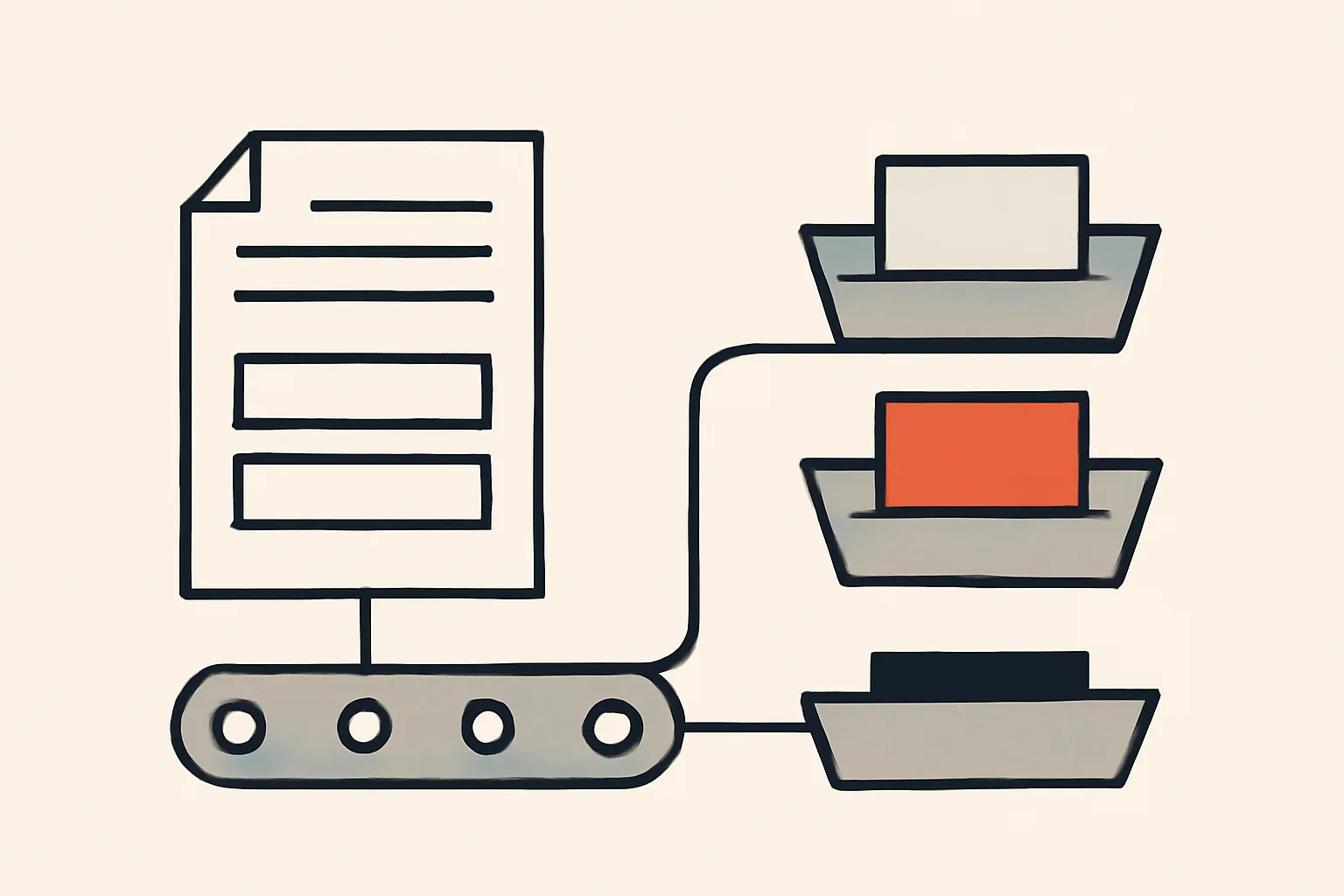
The process that volunteers itself
Every agency that starts an automation project starts it in the same place. Claims intake is high volume, it runs on rules a new hire can learn in a week, and the people doing it will tell you without being asked that it is the worst part of their job. It looks like the obvious first move, and every vendor you talk to will agree with you enthusiastically, because it is also the easiest thing they know how to sell.
We would ask you a different question first. Not how do we automate intake, but is the intake you have worth automating.
That question is almost never on the table, and its absence is the single most expensive thing about this category. Search for claims intake automation and page one is a wall of vendor glossaries and buyer's guides, all of which answer how. None of them ask whether. The gap is not an accident. Nobody selling intake software is paid to tell you that your form is the problem.
Rules-driven and high volume is a warning label
Those two properties are what make intake automatable. They are also what make automating it early so hard to undo.
Rules-driven means the process encodes a fixed set of decisions, and the field set is where those decisions live. High volume means whatever the field set gets wrong, it gets wrong thousands of times before anyone reviews it. Automate first and you have not removed the judgment from the process, you have hardened it. The form becomes the schema, the schema becomes the integration, the integration becomes the reporting, and by the time someone notices that you never captured the one field the carrier needs to avoid a follow-up, changing it is a project rather than an edit.
Manual intake has one underrated property: a CSR who knows the account fills the gap without telling anyone. She sees the missing loss date, she calls, she moves on. That improvisation is invisible, it never shows up in a process map, and it is holding the whole thing together. Automate the form and the improvisation is the first thing you delete. The gap it was covering is still there.
This is the pattern we see across processes that look clean on paper. Warranty claims in a dealership group look identical from the outside, rules-driven and repetitive, and they stay manual for reasons that have nothing to do with software. The mechanism is the same one we described in why dealership warranty claims are still manual: the process is not hard, the evidence requirement behind it is.
The number that sizes this
The industry publishes its own measure of how often intake fails, and it is not flattering. Between 15 and 20 percent of submitted applications, claims and policy updates are deemed not in good order because of missing or incorrect data, according to Hexure's summary of NIGO rates. On the life and annuity side the same body of research puts paper application NIGO rates around 60 percent, and even e-application rates near 40 percent, which is the more interesting figure. Those applications were submitted through a digital form. The form did not fix them.
Read that pairing carefully, because it is the whole argument. Digitizing intake moved the NIGO rate from 60 to 40 and stopped. The remaining 40 points are not a channel problem. They are a question-design problem, and no amount of intake automation touches them.
So run the arithmetic on your own book. If a fifth of what comes through intake comes back for missing information, an automated intake gives you incomplete submissions faster, at higher volume, with a clean timestamp proving exactly when you produced them. The rework does not disappear. It relocates, from the person who was in a position to catch it to a queue where nobody is.
Even the vendors concede this when you read past the headline. One 2026 intake guide states it plainly: if your manual intake skips fields or captures them inconsistently, automating it just produces clean garbage faster. The same guide's implementation checklist opens with confirming that the digital form captures every field the carrier requires and that validation rules block the common NIGO triggers, which is a prerequisite dressed up as step one. The dependency is right there in the sales material. It is simply positioned as something the software will handle rather than something you have to decide.
This is the general shape of the problem. Which parts apply to your process depends on answers only your systems can give.
Put us on it, from $5,000What fixing data capture actually means
It is not a data cleanup project, and it is not a new form. It is three findings, and they come out of your own file history rather than out of a requirements workshop.
The first is which fields cause the returns. Not which fields are blank, which is a different and much longer list. Pull ninety days of not-in-good-order items and sort them by what was actually missing. In most agencies this collapses to a handful of fields, and one or two of them are usually not on the form at all. Staff have been collecting them in the notes field for years.
The second is where in the process the field becomes knowable. A form that asks for something the claimant cannot possibly know at first notice is not a capture problem, it is a sequencing problem, and automating it produces a required field that everybody learns to fill with a placeholder. Placeholder values in a required field are worse than blanks. Blanks are visible.
The third is which carrier or line the returns concentrate in. This is nearly always lopsided. If two thirds of your returns trace to one carrier's submission requirements, you do not have an intake problem across the book, you have a mapping problem with one trading partner, and that is a conversation rather than a software purchase.
None of these three require a tool. They require someone to look, which is the part that keeps not happening, because looking is unglamorous and a demo is scheduled for Thursday.
Then automate, and the payback changes shape
Here is the part that makes the sequencing worth arguing about rather than just being correct in principle. Fixing capture first does not delay the automation. It changes what the automation is worth.
Automate a field set that produces a fifth of its output in a rework loop and your savings are capped by that loop, because every returned item costs more once it is being chased asynchronously by a system rather than immediately by a person. Fix the capture, then automate, and the same build removes the handling time and the rework at once. That is the difference between a two week payback and a rebuild eighteen months in, when the field set is load-bearing across four integrations and the honest fix has become a migration.
The sequencing is also what decides whether the project survives contact with your team. An intake automation that ships and then gets quietly worked around by the CSRs who know what it is missing has not failed loudly enough to get fixed. It just sits there, reporting throughput.
The broader principle is one we keep coming back to: the automation question and the process question are the same question, asked in the wrong order most of the time. We laid out the general version in when AI is the wrong answer to an operations problem. Intake is where the two collide most often, because it is the process most likely to be automated on enthusiasm rather than evidence.
We are not telling you not to automate claims intake. It is genuinely one of the highest-return processes in an agency, and eventually you should. We are telling you that the order is not a preference and it is not a best practice. It is the variable that decides the return.
Where this stops being an article
What we cannot tell you from here is what your ninety days of returned items say. That file is specific to your carriers, your lines, your submission requirements and the workarounds your staff invented to survive them, and it is the only input that determines whether your intake is ready to automate or needs a month of work first. Reading it takes access, not advice.
If you are being pitched claims intake automation right now, or you have already bought it and the rework has not moved, talk to us before the next build sprint. We will look at what your intake is failing to capture, tell you whether it is a form problem or a carrier problem, and give you an honest answer about the sequencing. Sometimes that answer is go ahead. Sometimes it is fix four fields first and save yourself the rebuild.