
Part of our work on private equity
Principal Investors and Private Equity
What Operational Diligence Finds That a Quality of Earnings Report Cannot
Big Sky Consulting Group · September 2, 2026 · 7 min read
The finding that arrives in month seven
You closed on a business doing eleven million in revenue with a clean quality of earnings report behind it. Add-backs documented, working capital peg agreed, customer concentration disclosed. The growth case assumed sixteen million inside three years, mostly organic, mostly through the sales hire you had lined up before the wire cleared.
Month seven, orders are up thirty percent and something has gone wrong in the back office. Invoices are going out late. Two customers have called about the same billing error. The controller who was cheerfully competent in diligence is now working Saturdays and has started using the phrase "when things calm down."
Nothing in the QoE was wrong. The report told you that last year's EBITDA was real. It did not tell you that last year's EBITDA was produced by four people doing manual work at a volume that could not go up, and that your growth case had quietly assumed otherwise.
That gap is the whole argument for operational diligence, and it is almost never described this way.
Two different things are wearing the same name
Search the term and page one splits in half. One half is limited partner diligence on fund managers: governance, custody, valuation policy, key person risk, the Scharfman book, the Wikipedia entry. Useful work, entirely unrelated to the company you are buying. The other half is advisory boilerplate telling you that operational due diligence examines how a business runs day to day, which is true in the way that saying a doctor examines a patient is true.
Neither half tells a sponsor what to actually go look for. So the default is that operational diligence becomes a slightly longer commercial diligence: supplier concentration, headcount by function, a site visit, a page on systems. It confirms things. It rarely changes a price.
The version that changes a price starts from a different question.
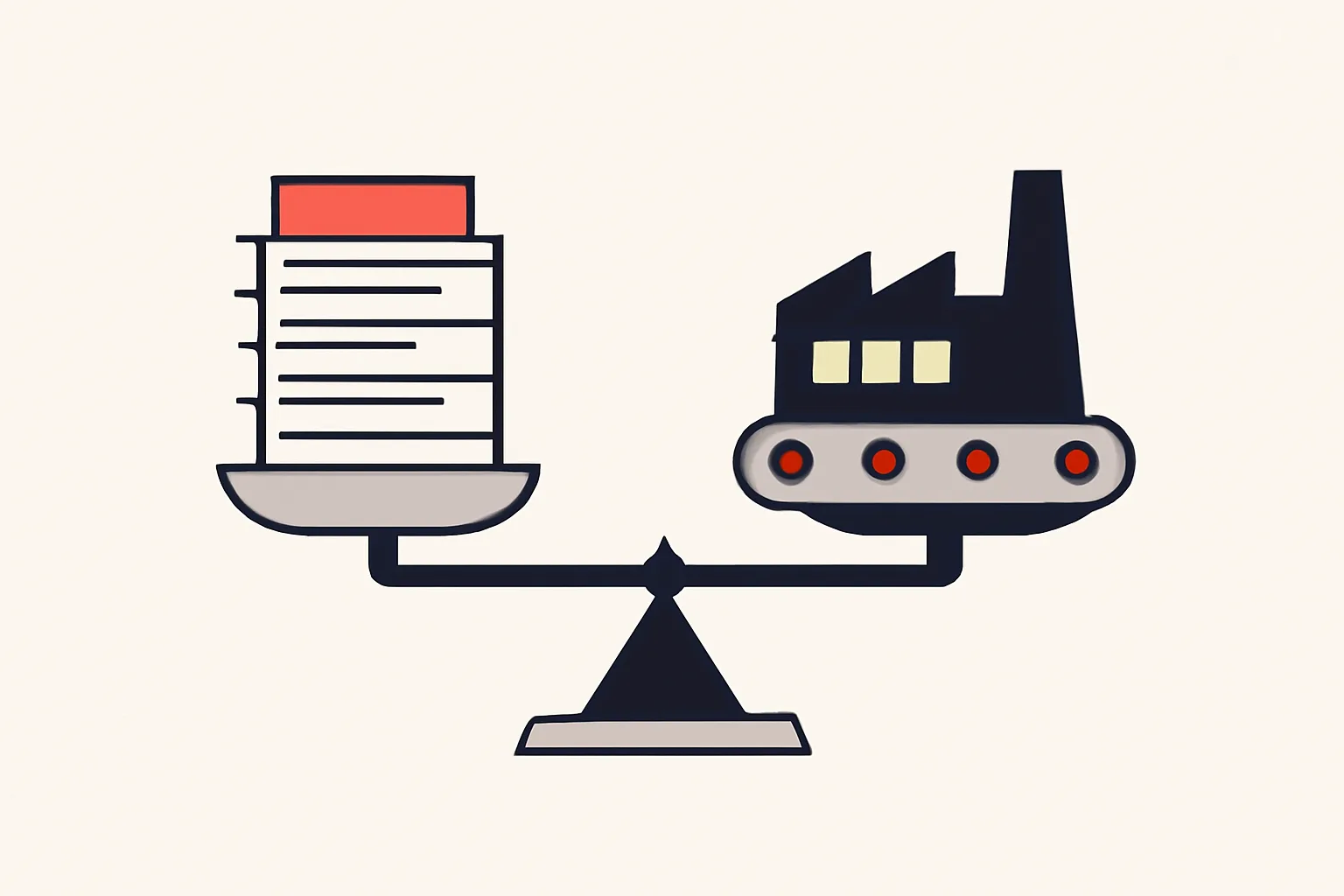
Financial diligence normalises the past. Operational diligence prices the future headcount.
A QoE is backward looking by design and honest about it. It takes reported earnings and adjusts them until they represent something sustainable: owner compensation restated to a market rate, personal expenses stripped out, related party rent marked to market, upfront-billed contracts and stale inventory corrected. Good QoE providers publish their own limits. One advisory firm working the ten to fifty million dollar range lists what its analysis routinely fails to catch: owner comp normalised too aggressively, one-time project revenue presented as run rate, deferred maintenance capex on trucks and roofs that never touches EBITDA and lands squarely in year one cash, accrued PTO and commissions that rarely make it into the working capital calculation.
Every one of those is a statement about what already happened. None of them is a statement about capacity.
Capacity is a different measurement. It asks what the current operating structure can absorb before it needs more people, and what those people cost. A business where every order touches a human twice has an EBITDA margin that is real today and mechanically falls as volume rises, because the cost line that produced the margin is a headcount line and headcount is a step function. You do not find that by normalising. You find it by counting touches.
The question to ask is not what happened at current volume. It is what breaks at 1.5 times volume.
Why this matters more now than it did in 2019
For most of the last decade the answer did not have to be very good. Bain's 2026 global report puts it plainly: in the 2010s a typical buyout needed about five percent annual EBITDA growth to hit a 2.5 times return over a five year hold. Cheap debt and rising multiples did the rest. Today the same deal needs roughly ten to twelve percent annual EBITDA growth to land in the same place. Bain calls it "12 is the new 5."
Hold periods have stretched to about seven years at exit, up from the five to six year average that ran from 2010 to 2021, and distributions to LPs sat flat at fourteen percent of net asset value in 2025, a level not seen since the financial crisis.
Read those three numbers together and the implication for diligence is specific, not rhetorical. Doubling the required growth rate while lengthening the hold means the operating structure has to survive a much larger volume increase than it used to, for longer, without margin erosion eating the growth. The gap between "the earnings are real" and "the earnings scale" used to be absorbed by multiple expansion. It is now the deal. The wider pressures on private markets, geopolitical and technological, push in the same direction.
EY frames its operational diligence work around scalability for exactly this reason, and its questions are the right shape: can the workforce ramp with available labour, what capital expenditure backlog exists from deferred investment, are management's savings targets robust or aspirational. Those questions have answers that move a model. "How does the business run day to day" does not.
This is the general shape of the problem. Which parts apply to your process depends on answers only your systems can give.
Put us on it, from $5,000What the finding actually looks like
The useful operational finding is rarely dramatic. It is usually a sentence like this one.
Order entry, credit checking, and invoicing are three passes over the same data by two people, in a system that was configured for a business half this size, and the reason nobody has fixed it is that the person who understands the workaround has been here nine years. At 1.5 times volume that is two more hires. At 2 times it is a system replacement during the growth year, or it is errors reaching customers.
That sentence does three things a QoE cannot. It converts a process observation into a headcount number. It puts that number on a volume trigger rather than a date. And it identifies a key person dependency that is invisible on an org chart, because the dependency is not the role, it is the undocumented workaround the role is carrying.
Once you have it, the finding is negotiable. It is a capex line in the model, or a price adjustment, or a first-hundred-days commitment, or a reason to sign anyway with the sequencing changed. What it is not is a surprise in month seven.
The trap on the other side is equally real, and it is the one sponsors walk into after they have been burned once. Finding a manual process does not mean you should automate it. A process that is manual and correct and running at sixty percent of capacity is not a problem, it is a business with headroom. Automating it buys you nothing and costs you a year of management attention during the exact period the value creation plan needs that attention elsewhere. We wrote about that failure mode at length in when AI is the wrong answer to an operations problem, and it applies with extra force inside a hold period, where the clock is the scarcest input.
Three things that make an operational diligence worth its fee
It produces numbers, not observations. Every finding should end in a figure: incremental headcount at a stated volume, deferred capex in year one cash, error rate multiplied by an average correction cost. If a finding cannot be priced it belongs in the site visit notes, not the investment committee memo.
It reads the growth case backwards. The growth case is the specification. Take the volume number the model assumes in year two and walk it through the actual process, station by station, asking what the current structure does with it. Most operational diligence never opens the model. That is the single biggest reason its findings do not travel to the committee.
It separates capacity from capability. These fail differently. A capacity constraint is arithmetic, it appears on schedule and you can price it. A capability gap, no one here has ever run a business at this size, appears at an unpredictable moment and cannot be fixed with a system. Sponsors routinely solve the first with software and the second with hope. The correct assignment is the reverse.
Vendor ROI models make the same category error one layer down, counting hours saved without counting what the saving costs to hold. Our recalculated automation ROI math covers the inputs those models leave out, and the arithmetic is the same arithmetic you need to defend a value creation plan to an IC.
Where writing stops
There is no checklist here for a reason. The stations that matter are different in a distribution business than in a services firm, the volume multiple worth testing depends on the growth case you actually underwrote, and the difference between a workaround that is a nuisance and one that is a cliff is a judgement call you make in the room, on the floor, watching someone work.
What an article can tell you is which question decides the outcome, and it is the one at the top. Ask what breaks at 1.5 times volume. If the answer comes back as a shrug or as a systems diagram, you do not have an answer yet.
If you are underwriting a growth case that assumes an operating structure you have not stress tested, or you are seven months into a hold and the back office has started working Saturdays, talk to us. We do not sell the software that would fix it, which is why we are willing to tell you when the answer is more people, or a different sequence, or nothing at all.