
Part of our work on consumer products
Consumer Products Industry
What a DTC Brand Has to Automate Before Its First Big Retail PO
Big Sky Consulting Group · August 31, 2026 · 6 min read
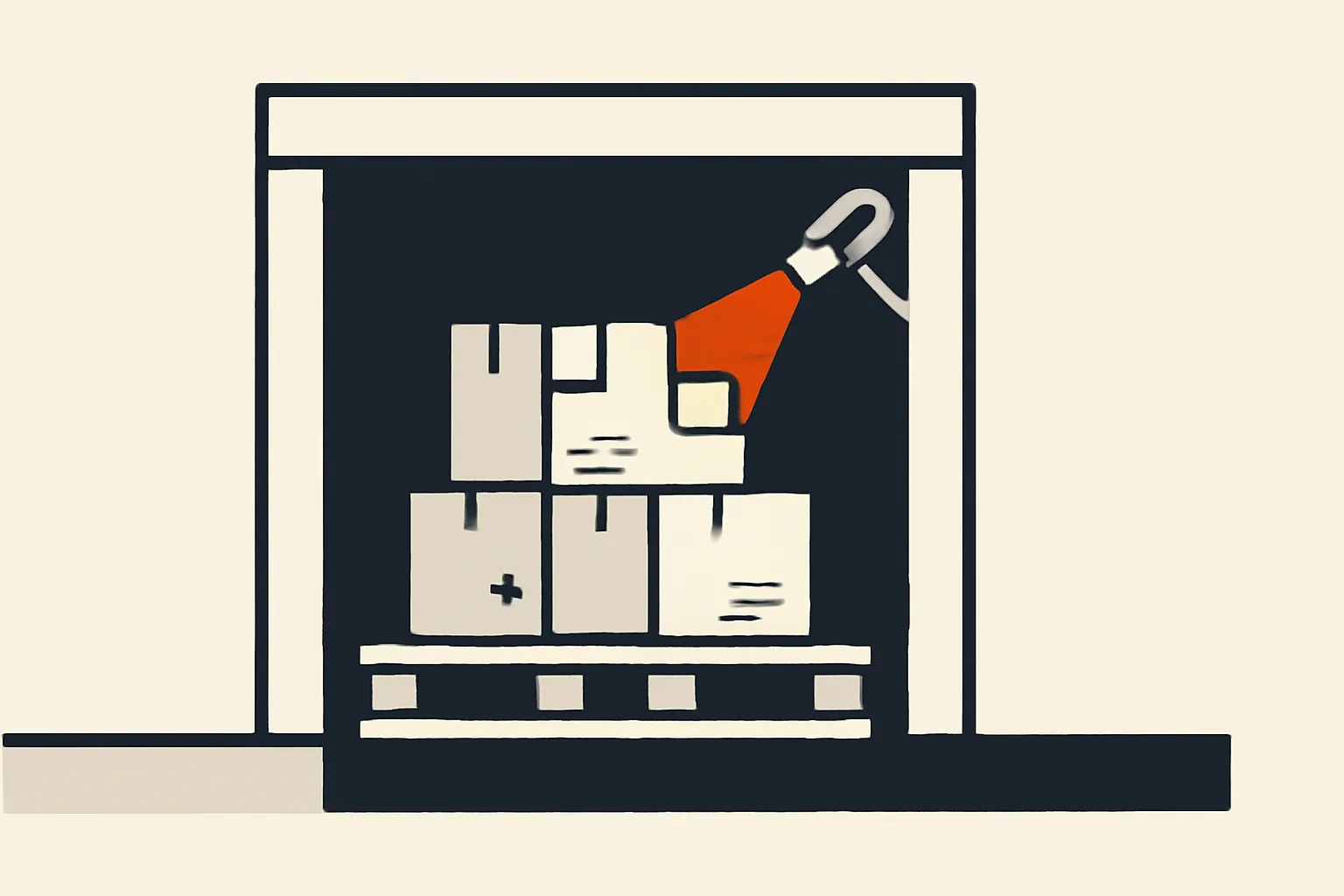
The shopping list you were handed is right, and in the wrong order
You signed the account. Somewhere in the paperwork there is a routing guide, and somewhere in the routing guide is a number that turns a missed delivery window into a deduction against your invoice. So you asked around, and everyone gave you the same list: EDI, GS1 labels, a WMS, a 3PL that has done this before.
Nothing on that list is wrong. The sequence is.
A first purchase order from a national retailer is not a larger version of your DTC business. It is a different counterparty, and the difference is that this one can fine you. Your DTC customer complains. Your retail customer debits the invoice, tells you afterward, and puts the burden of proof on you inside a window that is often 30 days and sometimes 15.
The first thing to build is not the ability to transmit documents. It is the ability to answer three questions on demand, for any order, months later:
- What did we promise?
- What did we ship?
- What did they receive?
Brands that automate transmission before they can answer those three end up sending perfectly compliant documents about a shipment nobody can reconstruct.
Why the penalty attaches to your warehouse, not your software
Walmart's on-time in-full program is the clearest example, because the terms are public and the enforcement is automatic. Non-compliant lines draw a fine of around 3 percent of cost of goods, scored at the purchase order line level, measured monthly. Prepaid suppliers, the ones controlling their own freight, are held to a 90 percent on-time bar; collect suppliers, where Walmart's carrier picks up, sit at 98 percent. Target runs the same logic under different names. Its fill rate program charges 5 percent of COGS on non-compliant items with a $150 minimum, and under the Perfect Order Program that began in May 2025, a missing or inaccurate EDI 856 draws 3 percent of COGS with no minimum at all.
Read those rules closely and a pattern falls out. Almost none of the money is lost on a technology failure. It is lost on a date, a quantity, and a match between the two. Your carrier missed the must-arrive-by date. Your co-packer shorted a line. Your 3PL built a pallet that scanned as something else at the door. The EDI worked fine. It faithfully transmitted a promise you then did not keep.
The transaction set itself is fixed and public. An 850 purchase order comes in, an 856 advance ship notice goes out with SSCC-18 carton labels, an 810 invoice follows. That is why every vendor on the first page of your search can credibly promise compliance: the format is a solved problem, and solved problems are easy to sell. What none of them can promise is your ship date. The part that is genuinely hard is the part nobody is selling you, which is a familiar shape once you have seen enough of these projects. It is the same reason we keep writing about when AI is the wrong answer to an operations problem: the available product is aimed at the tractable half of the problem.
The deduction arithmetic new brands walk into
The scale of this surprises founders, and it should not.
Across CPG, deductions of all kinds commonly run 5 to 15 percent of gross sales, and higher for brands spread across several channels. For a brand new to an account, or with a new SKU at an existing one, the early period is worse. In a Startup CPG session on fighting invalid deductions, the guidance to new brands was blunt: expect roughly half of invoice value to come back as deductions in the first six to twelve months. That is not a stable cost of doing business. It is the cost of arriving at a counterparty that meters you precisely while you are still estimating yourself.
What makes it recoverable is also what makes it dangerous. A meaningful share of those deductions are invalid, caused by the retailer's own receiving, your carrier, or your fulfillment partner. In the same session, an accounts receivable leader who ran the direct customer side at BodyArmor described $7.6 million of shortage deductions in 2024 against roughly $7 million recovered. That recovery rate is not a testament to better software. It is a testament to having records good enough to win an argument.
Which brings the whole thing back to the three questions. A dispute is not won by asserting that you shipped the goods. It is won by producing the promise, the proof of shipment, and the receiving evidence, in a form a compliance analyst can reconcile in a few minutes, before the window closes. If those three live in a founder's inbox, a 3PL portal you cannot export, and a spreadsheet someone maintains on Fridays, you do not have a dispute function. You have a filing cabinet with the drawers in three buildings.
This is the general shape of the problem. Which parts apply to your process depends on answers only your systems can give.
Put us on it, from $5,000What this actually means for sequencing
We are not going to tell you to skip EDI. You cannot ship to these accounts without it, and the deadline is on the PO.
But there is a decision underneath the shopping list that most brands never make explicitly, and it determines whether the next two years are profitable. Before you buy the integration, decide who owns the item master, the lot code scheme, the case configuration, and the ship confirmation. Right now, at a brand doing its first retail volume, the honest answer is usually that a co-packer and a 3PL own all four, and you have a relationship rather than a system of record. That is survivable in DTC, where nobody audits you. It is not survivable against an automated rule engine reading receiving scans.
The practical consequence is that some of what looks like an automation project is really an ownership project, and it is cheaper. Getting your own clean record of what was promised and what left the dock does not require a platform purchase. It requires deciding that the record is yours, and that it is captured at the moment the event happens rather than reconstructed at month end from whoever still remembers. That distinction between a workflow that runs and a workflow you can see is most of what orchestration actually means once you stop reading the brochure.
The order we generally argue for: own the data first, transmit second, optimize third. Vendors sell it in reverse because transmission is the part with a license attached.
There is one more piece of advice worth taking seriously, which is to be skeptical of your own first forecast. Retail buyers reset, promote, and drop doors, and a single account can move a double-digit share of a small brand's volume with one decision. Building your fulfillment plan around the PO you were shown is how brands end up short, and shorts are what the fine is for. If you want to be pessimistic about anything, be pessimistic about the pallet count. Call it a case of premature pack-ulation.
Where the writing stops
We can tell you which questions decide this. What did we promise, what did we ship, what did they receive, and who owns the answer. Those are the same three questions whether your first account is a national grocer, a mass retailer, or a club channel, and they are the ones that determine whether a deduction is a negotiation or a loss.
What an article cannot do is tell you which of your current partners is already generating the fines, whether your 3PL's data can be exported in a form that survives a dispute, or whether the integration quote on your desk is priced for the work you actually have. That takes a week inside your systems and your retailer paperwork, and the answers are specific to your accounts.
If you are staring at a first big purchase order and a routing guide written in a language nobody at your company speaks yet, talk to us before you sign the integration contract. The sequence is worth an hour, and it is a lot cheaper to fix now than in month seven, when the deductions arrive coded by the party that took the money.